
The news broke on our cricket WhatsApp group.
One message… then another… then another.
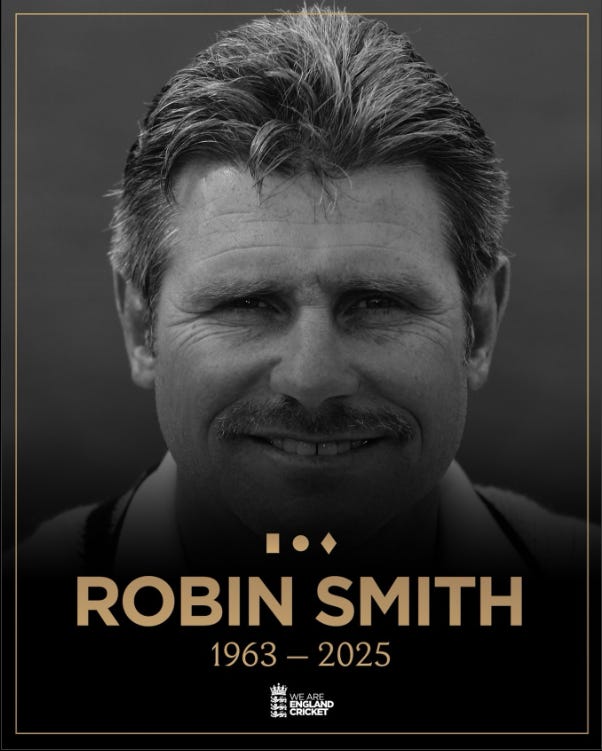
Robin Smith had passed.
The comments were full of respect and heartbreak — but as I read them, something in me cracked open. Because for me, Robin Smith wasn’t just a cricketer. As a boy, he was the hero.
I can still see him now:
Presence at the crease like very few men on earth.
Calm in chaos.
Time slowing down around him.
That fearless, almost regal way he carried the bat.
He made batting look easy — not because it was, but because he was larger than life.
I never modelled myself on him.
But I desperately wished I could.
He was everything I believed a man should be.
And yet… beneath that presence, beneath the legend… he was human.
And today, he is gone.
I sat in a coffee shop reading the messages, and tears just came. Not gentle tears — proper, uninvited, burning ones. Because this isn’t only the loss of a sporting great. It’s the loss of a man whose wisdom, story, and humanity extended far beyond the cricket field.
But it’s more than that.
It’s the same story I’ve seen far too many times.
I’ve lost three friends — all midlife men — to suicide. Good men. Decent men. Men with wives, children, colleagues, friendships. Men who were not alone… but felt like they were.
And I grieve Robin today in the same way:
Not just for the man we lost,
but for the unimaginable suffering he must have carried quietly.
Because somewhere along the line, men were sold a lie:
that suffering makes you weak.
that being human is a flaw.
that emotions are a threat to masculinity.
that “success” is measured in material comfort, status, income, or control.
But here’s the truth:
And real men — whole men — hurt.
We ache.
We get lost.
We drown under expectations.
We break under the weight of what we think we should be.
I know this because I’ve lived it.
There was a day — I remember it vividly — sitting with a board pack in front of me and staring at a bookcase in the office. Something inside me whispered:
“I am not okay.”
Not the dramatic collapse Hollywood portrays.
Just a quiet internal death.
An emptiness so sharp it finally made me admit:
The life I was living was not the life I was made for.
I was blessed — people, learning, and faith helped guide me through it.
But many men don’t get that lifeline in time.
We chase financial freedom, as if it will save us.
But what is financial freedom worth if you die trying to reach it?
Men aren’t dying because they’re weak.
They’re dying because the story is broken.
A story that tells men:
emotions are a luxury
pain should be private
contribution equals income
vulnerability equals failure
It’s nonsense.
We are human beings before we are providers.
We are relational creatures — designed for connection, for brotherhood, for meaning.
We are each unique, with gifts the world desperately needs.
And burying those gifts to conform to the world’s metrics of success is killing us.
Sometimes quietly.
Sometimes catastrophically.
So let me ask the question that matters:
Sit with that.
Let it rearrange you.
Because if the answer is anything deeper than “he had a nice car” or “he made good money,” then maybe — just maybe — the story we’ve been handed isn’t the story we were designed to live.
This generation of men can break the pattern.
But it starts with one honest conversation.
So if you’re in a tough space — truly — don’t disappear into silence.
Reach out.
To a trusted mate.
To a partner.
To someone who will hold your truth gently.
You’re not broken.
You’re not a burden.
You’re not alone.
You’re a man.
A human one.
And that is more than enough.
There’s no pressure — just conversation.
And this article is also available on the Aruka Solutions website.